
- Home
- Artists & Makers
- R.B. Wilson
R.B. Wilson
1868 - 1947
Robert Black "Buff" Wilson was a Scottish professional golfer and highly regarded clubmaker who, despite working across Britain, Europe, and the United States, always considered St Andrews his home. Born in Anstruther in 1868, Wilson learned the craft of clubmaking as an apprentice to Old Tom Morris in St Andrews during the 1880s, an experience he later credited as the foundation of his entire career.
Although his competitive record was respectable rather than exceptional, Wilson enjoyed a long playing career in the late nineteenth and early twentieth centuries. He competed in the Open Championship in 1890 and 1893, finishing 22nd and 33rd respectively, and later travelled to the United States where he played in both the 1896 and 1897 U.S. Opens. His best result came at Shinnecock Hills in 1896, where he finished ninth.
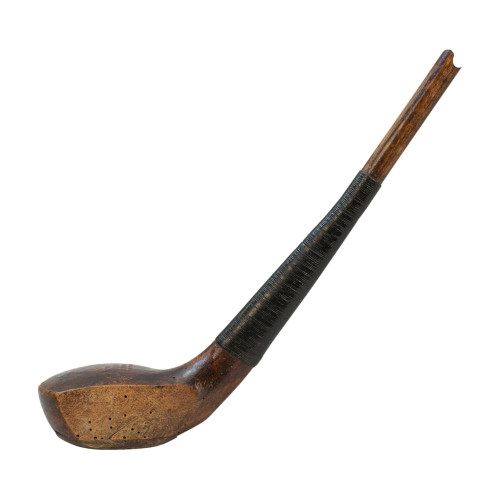
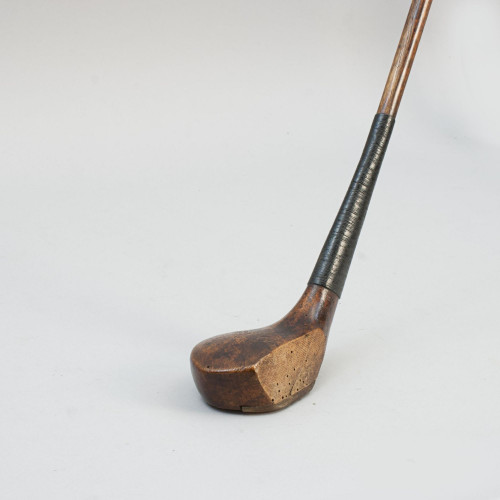
Wilson's greater reputation came through his work as a clubmaker. During the 1890s he became especially associated with the mashie-cleek, a speciality club that gained widespread attention after being successfully used and endorsed by golfer Douglas Rolland in numerous match play events. Wilson also produced finely crafted long-nosed woods, many stamped with his distinctive oval signature reading "R.B. Wilson, Maker, St Andrews." Around the turn of the century he patented several innovative club designs, including the "Model 1000" putter, which featured one or two large holes in the face, and the hosel-less "A-1" putter.
His professional appointments took him to several clubs, beginning at Minchinhampton, where he also contributed to course design, before moving through Sheffield, Sidcup, and Beckenham.
Robert Black "Buff" Wilson was a Scottish professional golfer and highly regarded clubmaker who, despite working across Britain, Europe, and the United States, always considered St Andrews his home. Born in Anstruther in 1868, Wilson learned the craft of clubmaking as an apprentice to Old Tom Morris in St Andrews during the 1880s, an experience he later credited as the foundation of his entire career.
Although his competitive record was respectable rather than exceptional, Wilson enjoyed a long playing career in the late nineteenth and early twentieth centuries. He competed in the Open Championship in 1890 and 1893, finishing 22nd and 33rd respectively, and later travelled to the United States where he played in both the 1896 and 1897 U.S. Opens. His best result came at Shinnecock Hills in 1896, where he finished ninth.
Wilson's greater reputation came through his work as a clubmaker. During the 1890s he became especially associated with the mashie-cleek, a speciality club that gained widespread attention after being successfully used and endorsed by golfer Douglas Rolland in numerous match play events. Wilson also produced finely crafted long-nosed woods, many stamped with his distinctive oval signature reading "R.B. Wilson, Maker, St Andrews." Around the turn of the century he patented several innovative club designs, including the "Model 1000" putter, which featured one or two large holes in the face, and the hosel-less "A-1" putter.
His professional appointments took him to several clubs, beginning at Minchinhampton, where he also contributed to course design, before moving through Sheffield, Sidcup, and Beckenham.
He later worked in America at Shinnecock Hills Golf Club on Long Island and Lakewood Golf Club in New Jersey, importing thousands of his "R.B. Wilson O.K. Special" clubs for distribution across North America. In 1905 he briefly held a position at the Wentorf-Reinbek Club in Germany before returning permanently to Scotland.
Even while working abroad, Wilson regularly returned to St Andrews during the winter months to continue making clubs in his workshop. After retiring from clubmaking in 1910, he remained a familiar figure in the town, earning a living selling newspapers from a barrow in the streets of St Andrews.
1 ITEM
Please create wishlist to add this item to
