
- Home
- Artists & Makers
- Thomas Aldred
Thomas Aldred
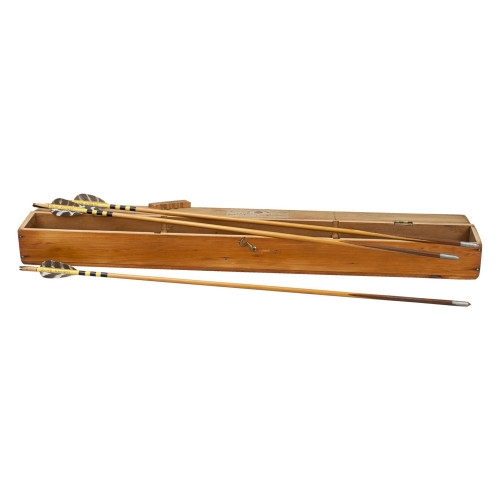
Thomas Aldred was a distinguished Victorian archery equipment maker and sporting goods manufacturer based in London during the height of 19th-century recreational archery. Operating in the period when target archery flourished as a fashionable and competitive pastime (c. 1837-1901), Aldred became known for both the quality of his craftsmanship and his technical innovations in bow and arrow design.
Aldred specialised in the manufacture of traditional English yew bows, produced through an exceptionally long and meticulous process. His method is recorded as taking up to five years per bow: approximately three years to season and prepare the yew stave, one year for glue-setting and initial shaping (including handle splice work), and a further year dedicated to final finishing and refinement. This extended production cycle reflects the high standards associated with premium Victorian bow making.
He operated under the trade name "Thomas Aldred, Archery & Fishing Tackle Manufacturer", and advertised himself as a holder of six prize medals, reflecting recognition within sporting and industrial exhibitions of the period. His London premises are recorded at various times as 258 Oxford Street (later style) and 110 Edgware Road, London, W., indicating both commercial expansion and relocation within major retail districts.
In addition to bows and arrows, Aldred also produced a wide range of sporting goods, including fishing tackle, reflecting the Victorian trend of diversified sporting equipment manufacturers serving a growing leisure market.
Aldred is also associated with innovation in archery equipment design. A notable example is his registered design for the "Paragon" archery tip, recorded in 1868 (Registered
Thomas Aldred was a distinguished Victorian archery equipment maker and sporting goods manufacturer based in London during the height of 19th-century recreational archery. Operating in the period when target archery flourished as a fashionable and competitive pastime (c. 1837-1901), Aldred became known for both the quality of his craftsmanship and his technical innovations in bow and arrow design.
Aldred specialised in the manufacture of traditional English yew bows, produced through an exceptionally long and meticulous process. His method is recorded as taking up to five years per bow: approximately three years to season and prepare the yew stave, one year for glue-setting and initial shaping (including handle splice work), and a further year dedicated to final finishing and refinement. This extended production cycle reflects the high standards associated with premium Victorian bow making.
He operated under the trade name "Thomas Aldred, Archery & Fishing Tackle Manufacturer", and advertised himself as a holder of six prize medals, reflecting recognition within sporting and industrial exhibitions of the period. His London premises are recorded at various times as 258 Oxford Street (later style) and 110 Edgware Road, London, W., indicating both commercial expansion and relocation within major retail districts.
In addition to bows and arrows, Aldred also produced a wide range of sporting goods, including fishing tackle, reflecting the Victorian trend of diversified sporting equipment manufacturers serving a growing leisure market.
Aldred is also associated with innovation in archery equipment design. A notable example is his registered design for the "Paragon" archery tip, recorded in 1868 (Registered
Design No. 4950), held in the National Archives. This demonstrates his involvement not only in traditional craftsmanship but also in improving functional components of archery equipment.
His work contributed to the broader Victorian archery revival, a period when organised target archery became a respected social sport supported by clubs, competitions, and specialist manufacturers. Aldred's bows and equipment were part of the competitive landscape alongside other notable makers of the time.
Thomas Aldred's legacy lies in the combination of traditional bow-making skill and industrial-era innovation. His long-production yew bows represent the high craftsmanship of Victorian archery manufacture, while his patented designs reflect the increasing formalisation and technical development of sporting goods in the 19th century.
9 ITEMS


Please create wishlist to add this item to
